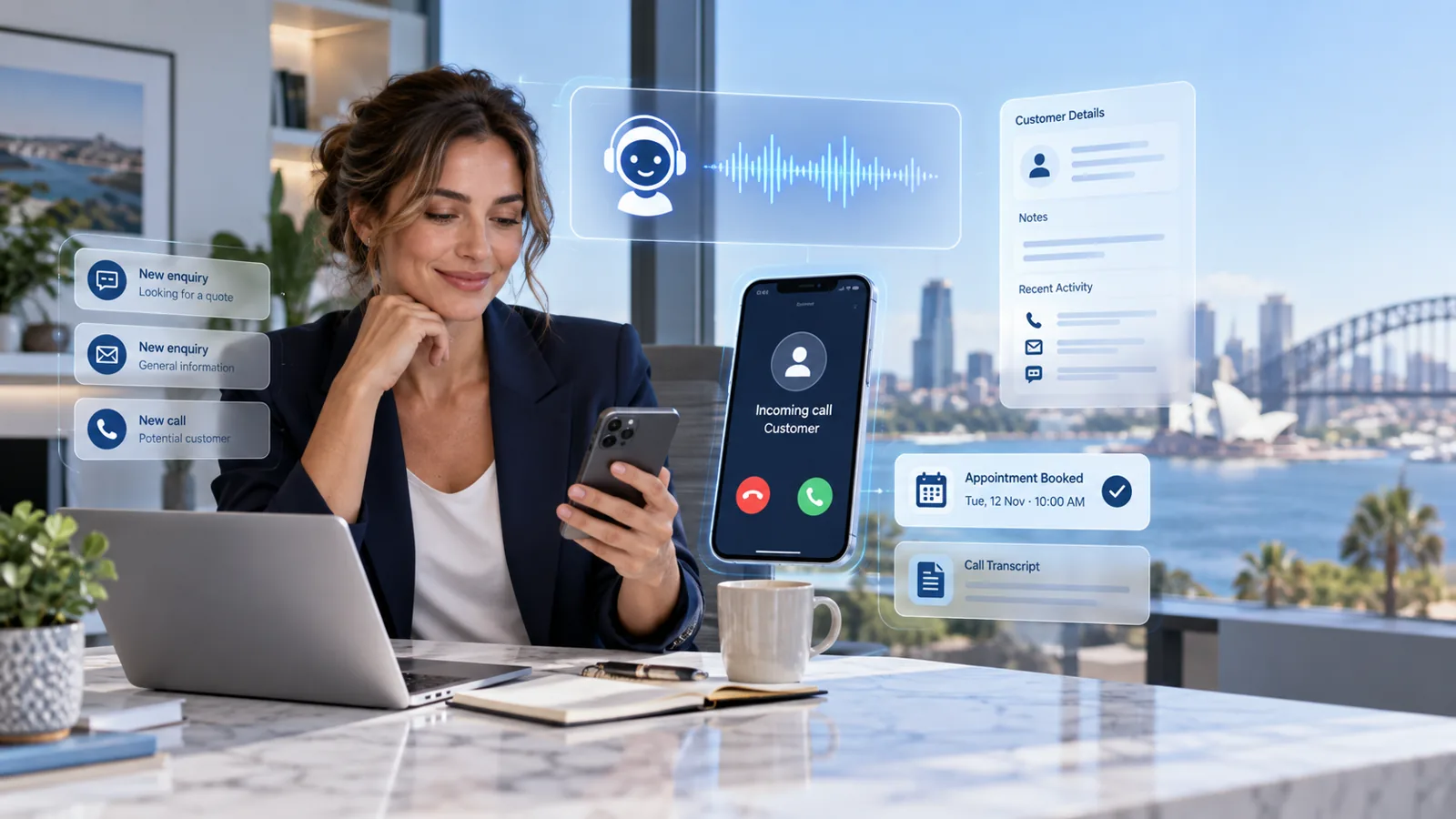
For many Australian small businesses, the telephone is still one of the most important ways customers make contact.
A potential customer might call to request a quote, make an appointment, check availability, ask about a service or discuss an urgent problem.
But what happens when nobody answers?
The owner might be working on-site. The receptionist could already be speaking with another customer. The office may be closed for the day.
When that happens, an important business opportunity can easily become a missed call.
This is one of the reasons AI receptionists for small businesses in Australia are becoming increasingly useful.
Instead of sending callers directly to voicemail, an AI receptionist can answer the phone, understand what the caller needs, collect important information and determine the appropriate next step.
Depending on how the system is configured, it can even book appointments, qualify enquiries, update a CRM and transfer important calls to a member of the team.
For a broader introduction to this technology, read our AI Voice Agents in Australia: Complete Business Guide.
What Is an AI Receptionist?
An AI receptionist is an intelligent phone answering system that uses conversational artificial intelligence to communicate with callers.
Unlike traditional automated phone menus that ask customers to:
“Press 1 for sales.”
“Press 2 for support.”
An AI receptionist allows the caller to simply explain what they need.
For example, a customer might say:
“I need someone to repair my leaking roof.”
The AI receptionist can respond naturally and ask relevant questions such as:
- Where is the property located?
- How urgent is the problem?
- Is water currently entering the property?
- What is the best contact number?
- When would you like someone to attend?
The information can then be recorded and passed to the appropriate employee.
Modern AI receptionists therefore do much more than simply answer the telephone.
They can become part of the business’s wider customer enquiry, sales and CRM automation process.
Why Small Businesses Miss Phone Calls
Small businesses often operate differently from large companies with dedicated call centres.
Employees may regularly be:
- working on-site
- meeting customers
- driving between appointments
- completing jobs
- handling another telephone call
- attending meetings
- working outside normal office hours
For trades and service businesses in particular, constantly answering the telephone can be difficult.
But the customer calling the business may be ready to buy.
They may have found the company through Google, social media, advertising or a referral and want to speak with someone immediately.
An AI receptionist can provide a first point of contact when the team is unavailable.
How an AI Receptionist Can Help Australian Small Businesses
1. Answer Calls 24/7
One of the biggest advantages of an AI receptionist is availability.
Calls can be answered during business hours, after hours, on weekends or whenever staff members are unable to pick up.
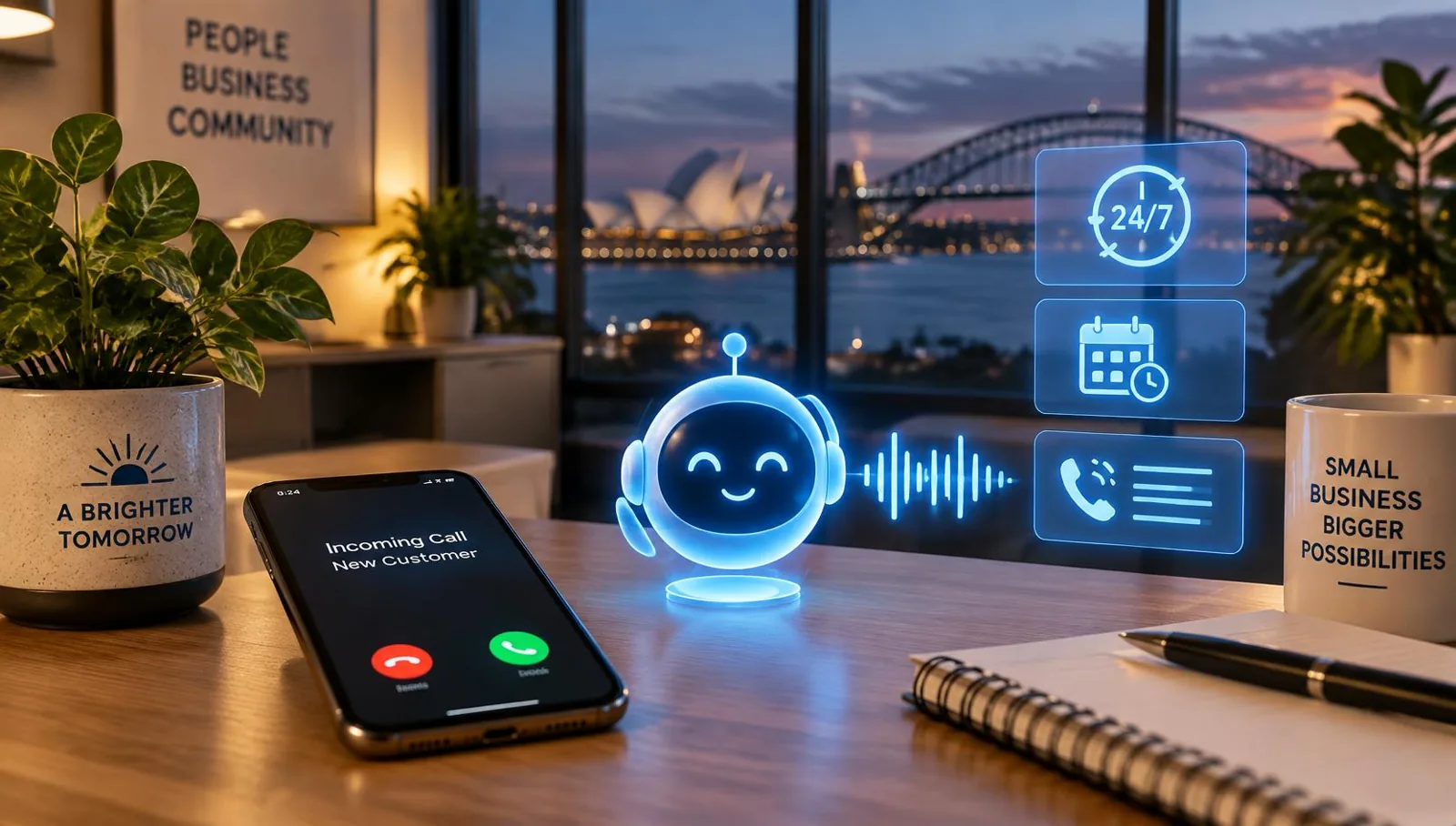
Businesses can decide when AI should answer.
For example:
Business hours: AI answers only when employees are busy.
After hours: AI automatically manages incoming enquiries.
Overflow: AI answers when several customers call at the same time.
24/7: AI becomes the first point of contact for every incoming call.
The business remains in control of the process.
2. Capture New Leads
A missed call may contain a valuable new enquiry.
Instead of simply asking the customer to leave a voicemail, an AI receptionist can collect useful information immediately.
This might include:
- customer name
- phone number
- email address
- suburb
- service required
- project details
- preferred appointment time
- urgency of the enquiry
The information can then be sent directly to the sales or service team.
This gives employees more context before they return the call.
Businesses can take this further by connecting captured enquiries with a Sales CRM so leads can be organised, assigned and followed up from one system.
3. Qualify Enquiries
Not every incoming call requires the same level of attention.
An AI receptionist can ask predefined qualification questions to understand the opportunity.
Imagine a roofing company receiving a call.
The AI might determine whether the customer needs:
- roof repairs
- roof restoration
- roof replacement
- gutter repairs
- emergency leak assistance
- a general quotation
The enquiry can then be categorised before it reaches the team.
Salespeople spend less time asking basic questions and more time handling enquiries where their knowledge and experience are required.
4. Book Appointments
When connected with an appropriate calendar or booking system, an AI receptionist can potentially help customers schedule appointments during the phone conversation.
For example, a customer calls an automotive workshop.
They explain that their vehicle needs servicing.
The AI collects the vehicle information and preferred date.
Available appointment times can then be presented to the customer.
Once confirmed, the booking can be added to the relevant system and the customer can receive confirmation.
This turns a telephone enquiry directly into a business outcome.
5. Answer Frequently Asked Questions
Small businesses often receive the same questions throughout the day.
Customers may ask:
“What areas do you service?”
“What time do you open?”
“Do you provide free quotes?”
“Do you work on Saturdays?”
“Where are you located?”
“Do you provide commercial services?”
An AI receptionist can be provided with approved business information so it can respond consistently to common questions.
When the question requires specialist knowledge or human judgement, the conversation can be escalated instead.
6. Transfer Important Calls
AI should not prevent customers from speaking with people.
A well-designed AI receptionist should know when human involvement is required.
Businesses can create transfer rules for situations such as:
- urgent enquiries
- existing important customers
- complaints
- complex technical questions
- high-value opportunities
- sensitive conversations
- customers specifically requesting an employee
The AI can capture the initial information before transferring the caller.
This can help the employee understand why the person is calling before taking over the conversation.
7. Connect Calls with Your CRM
The real value of an AI receptionist becomes clearer when telephone conversations are connected with the rest of the business.
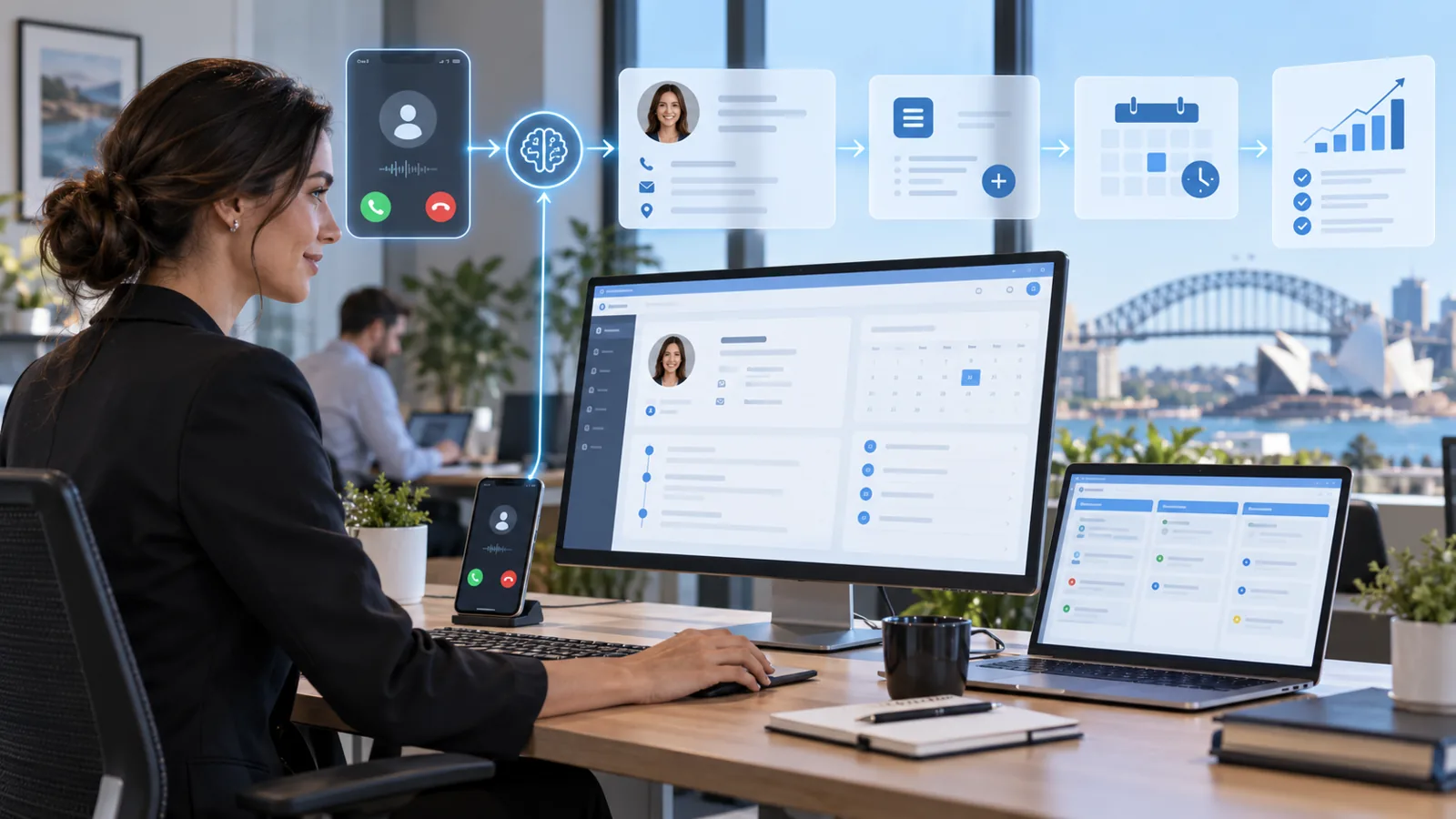
Consider this workflow:
Customer calls → AI answers → Enquiry identified → Customer details collected → CRM record created → Salesperson assigned → Appointment requested → Follow-up created
Instead of information remaining inside a voicemail or handwritten note, the conversation becomes part of an organised workflow.
For businesses already using CRM software, this can improve how enquiries are managed and followed up.
NextWeb’s AI Automation platform can also connect triggers and actions across different stages of a business workflow.
AI Receptionist Example for a Plumbing Business
Imagine a plumbing company in Sydney.
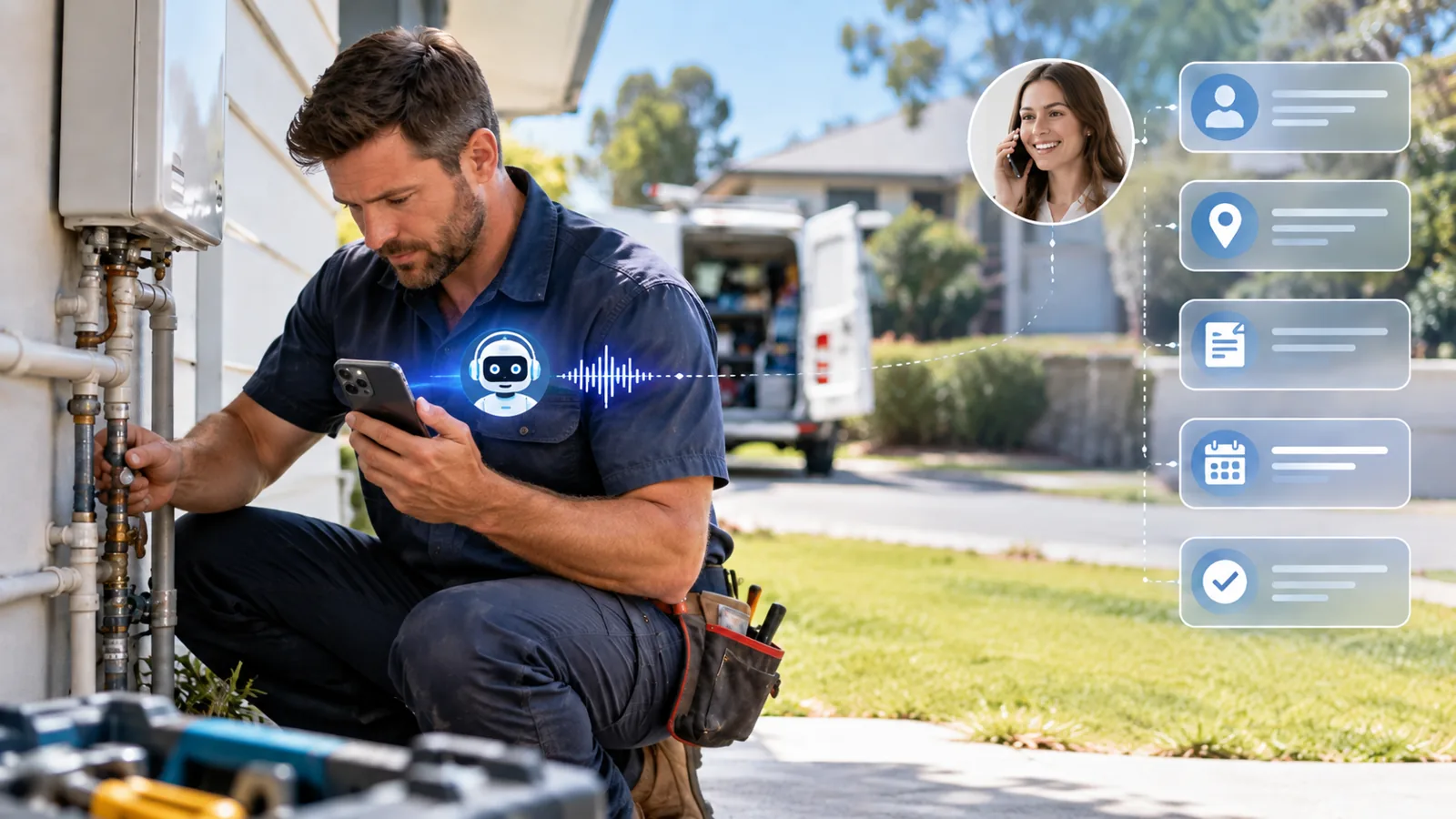
At 7:15 pm, a homeowner discovers a leaking pipe and searches Google for a nearby plumber.
They call the business.
Normally, the office is closed and the call goes to voicemail.
With an AI receptionist, the conversation could be different.
The system answers:
“Thanks for calling ABC Plumbing. How can I help?”
The customer explains that water is leaking underneath the kitchen sink.
The AI collects:
- customer name
- phone number
- property address
- suburb
- type of problem
- urgency
The enquiry can then be classified according to the business’s agreed process.
An urgent notification could be sent to the appropriate team member or a call-back could be scheduled.
The caller has received an immediate response, while the business has captured the information required to take action.
Which Small Businesses Can Use an AI Receptionist?
AI receptionists can be useful for many Australian businesses where telephone enquiries follow reasonably repeatable processes.
Trades and Home Services
Plumbers, electricians, roofers, builders, cleaners, landscapers, tilers, removalists and other trades can capture enquiries while their teams are working on-site.
Real Estate
Property businesses can manage rental enquiries, buyer enquiries, inspection requests and maintenance calls.
Automotive Businesses
Workshops can collect vehicle information, service enquiries and appointment requests.
Accounting and Professional Services
AI can capture initial enquiries and arrange consultations while leaving professional advice to qualified staff.
Beauty and Wellness
Salons and service providers can manage appointment enquiries, operating hours and booking requests.
Restaurants and Hospitality
AI receptionists can assist with reservations, opening hours and common venue enquiries.
Medical and Allied Health Administration
Appropriately configured systems can help with administrative enquiries and appointment requests, with additional care required around privacy and sensitive information.
AI Receptionist vs Voicemail
Traditional voicemail primarily records a message.
An AI receptionist can potentially turn the conversation into structured information.
Voicemail
Customer calls → Nobody answers → Customer leaves message → Employee listens later → Employee calls back
AI Receptionist
Customer calls → AI answers → Requirement identified → Details captured → Enquiry classified → CRM updated → Next action triggered
The major difference is what happens after the telephone rings.
AI Receptionist vs Human Receptionist
An AI receptionist does not necessarily need to replace a human receptionist.
The two can work together.
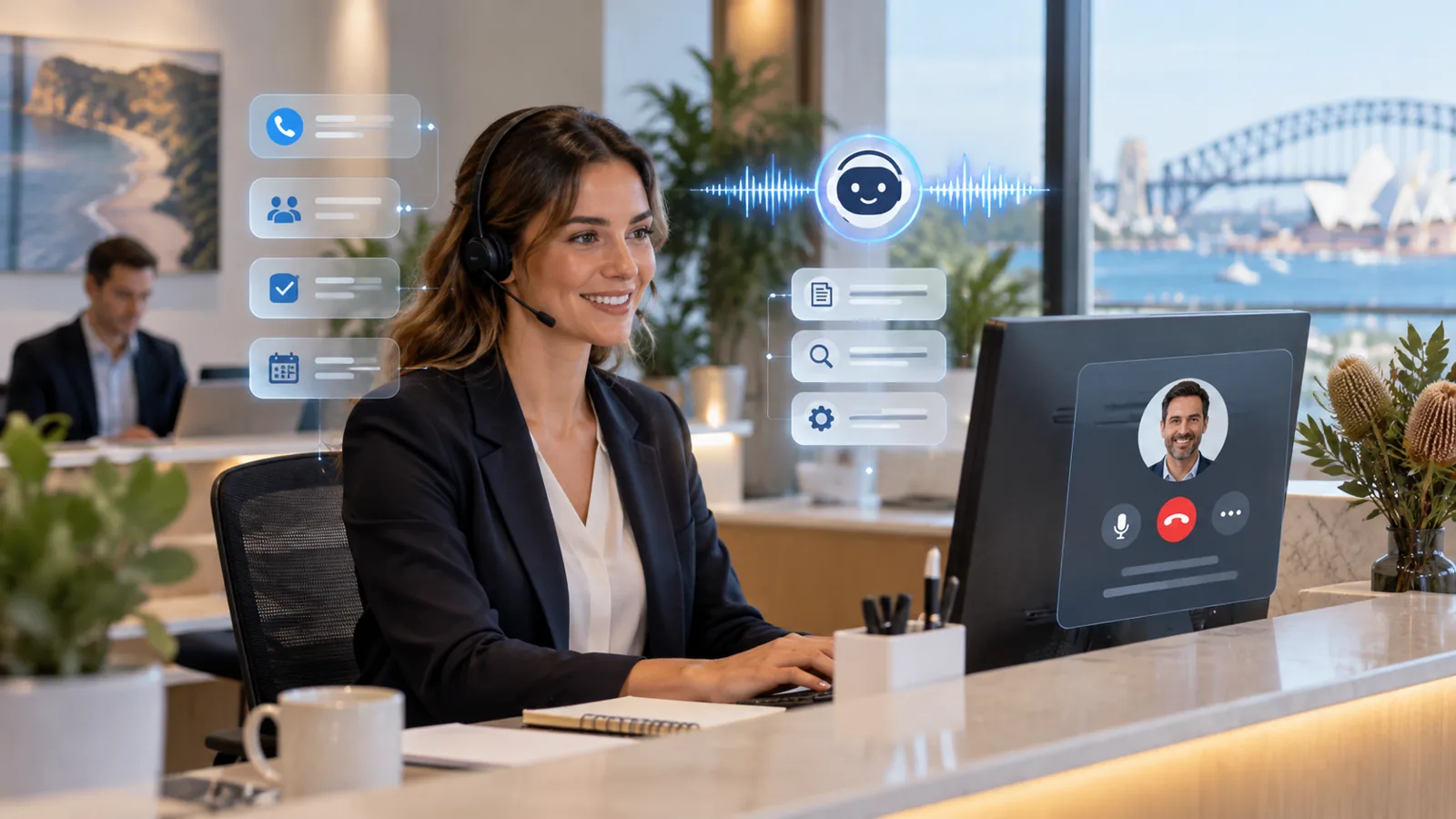
AI is particularly suitable for:
- repetitive enquiries
- after-hours calls
- overflow calls
- basic qualification
- appointment requests
- information collection
- initial call routing
People remain important when conversations involve:
- empathy
- negotiation
- specialist expertise
- unusual situations
- complex decisions
- relationship management
For many small businesses, the practical model is therefore AI plus people.
AI handles repetitive processes while employees focus on conversations where human knowledge and judgement add the most value.
What Should an AI Receptionist Know About Your Business?
Before introducing an AI receptionist, businesses should clearly define what the agent can and cannot do.
Important information can include:
- business name
- opening hours
- services
- service areas
- pricing information that can be shared
- appointment rules
- qualification questions
- frequently asked questions
- escalation procedures
- emergency rules
- departments
- employee contact rules
The more clearly the business process is defined, the more effectively the AI receptionist can operate.
What Happens If the AI Does Not Know the Answer?
This is an important part of designing an AI phone system.
An AI receptionist should have clear fall-back instructions.
For example, it can:
- Ask the customer to clarify the question.
- Check approved business information.
- Collect the customer’s details.
- Arrange a call-back.
- Transfer the caller.
- Create a support request.
The objective should not be for AI to answer every possible question.
The objective should be ensuring that every caller has an appropriate next step.
Privacy and Responsible AI Use in Australia
Businesses introducing AI into customer communications should consider privacy, security and data-handling requirements.
An AI receptionist may collect information such as:
- customer names
- telephone numbers
- email addresses
- addresses
- enquiry details
- appointment information
The Office of the Australian Information Commissioner (OAIC) provides guidance for Australian organisations about the collection and handling of personal information.
Businesses should understand:
- what customer information is being collected
- why the information is required
- where the information is stored
- which systems receive the information
- who can access it
- how long information is retained
- whether additional privacy obligations apply to their organisation
Businesses should also obtain appropriate professional advice where required rather than assuming the same privacy requirements apply to every organisation.
What about AI Outbound Calls?
AI voice technology can also be used for certain outbound workflows, such as:
- appointment confirmations
- existing enquiry follow-ups
- customer reminders
- service notifications
- approved sales follow-up processes
However, outbound calling needs to be designed carefully.
Australian businesses considering promotional or telemarketing calls should review the current requirements published by the Australian Communications and Media Authority (ACMA), including applicable calling times, identification requirements and Do Not Call Register rules.
AI automation does not remove a business’s responsibility to follow applicable communication and privacy requirements.
From AI Receptionist to Complete AI Voice Agent
An AI receptionist is often only the first step.
Once telephone conversations become connected with business systems, AI can support much wider workflows.
For example:
Incoming enquiry → AI qualification → CRM → Booking → Confirmation → Staff notification → Follow-up
This is where an AI receptionist begins to become a more complete AI voice agent.
Learn more in our main guide: AI Voice Agents in Australia: Complete 2026 Business Guide.
Why AI Receptionists Are Becoming Important for Australian Businesses
Customers expect businesses to respond quickly.
At the same time, small businesses cannot always have an employee available to answer every telephone call.
AI receptionists provide another option.
They can help businesses answer calls, capture customer information, organise enquiries and automate routine steps while keeping employees involved when their expertise is required.
The biggest opportunity is not simply having AI answer the telephone.
It is connecting the conversation with what happens next.
Build an AI Receptionist Around Your Business
NextWeb helps Australian businesses create AI voice and automation solutions designed around real business processes.
An AI receptionist can be configured to help with:
- 24/7 call answering
- lead capture
- lead qualification
- appointment booking
- CRM integration
- call routing
- customer follow-up
- automated workflows
- staff notifications
- call summaries
Rather than introducing another disconnected piece of software, the goal is to connect conversations with the systems your team already uses.
Want to see how an AI receptionist could work for your business?
Contact NextWeb to discuss an AI voice solution designed around your enquiries, sales process and existing business systems.
Frequently Asked Questions
What is an AI receptionist?
An AI receptionist is an intelligent phone system that can communicate conversationally with callers, answer common questions, collect information and perform predefined actions such as booking appointments or routing enquiries.
Can an AI receptionist answer calls after hours?
Yes. An AI receptionist can be configured to answer calls outside normal business hours, during busy periods or 24/7.
Can an AI receptionist use my existing business number?
Depending on the telephone setup, businesses can often route or forward appropriate calls from an existing business number into an AI voice system.
Can an AI receptionist book appointments?
Yes, when connected with a compatible booking or calendar system and configured with the appropriate business rules.
Can an AI receptionist connect with a CRM?
Yes. CRM integration can allow information collected during the call to create or update customer and lead records automatically.
Is an AI receptionist suitable for tradies?
It can be particularly useful for trades businesses because employees are frequently on-site and unable to answer every incoming call.
Will an AI receptionist replace my staff?
It does not need to. Businesses can use AI to manage repetitive, overflow or after-hours conversations while employees handle complex, sensitive and relationship-focused interactions.
For a complete overview of how AI voice technology can transform business communication, read our AI Voice Agents in Australia: Complete Business Guide.